A respectful work environment depends on attentive behavior, clear processes, and a confident approach to boundary violations. You learn to recognize, classify, and appropriately address problematic behavior.

20 min
Multimodal
Über 30 Sprachen
Teilnahmebescheinigung
Bullying and sexual harassment in the workplace cause billions in damages every year through sick leave, staff turnover, and lawsuits, and the employer is liable under the General Act on Equal Treatment (AGG) if it has not taken preventive measures. Employees must be able to recognize warning signs, respect boundaries, and respond correctly when they suspect misconduct. A respectful work environment is not created by mission statements but by trained competence at all levels.
00 Fundamentals of bullying and sexual harassment
01 Bullying and sexual harassment in everyday work
02 Consequences of bullying and sexual harassment
03 Summary
04 Knowledge check incl. certificate of completion
The entire workforce that needs to recognize warning signs; modular and suitable as initial training for new employees and as an annual refresher.
Leading organizations trust Bridgly
.png)

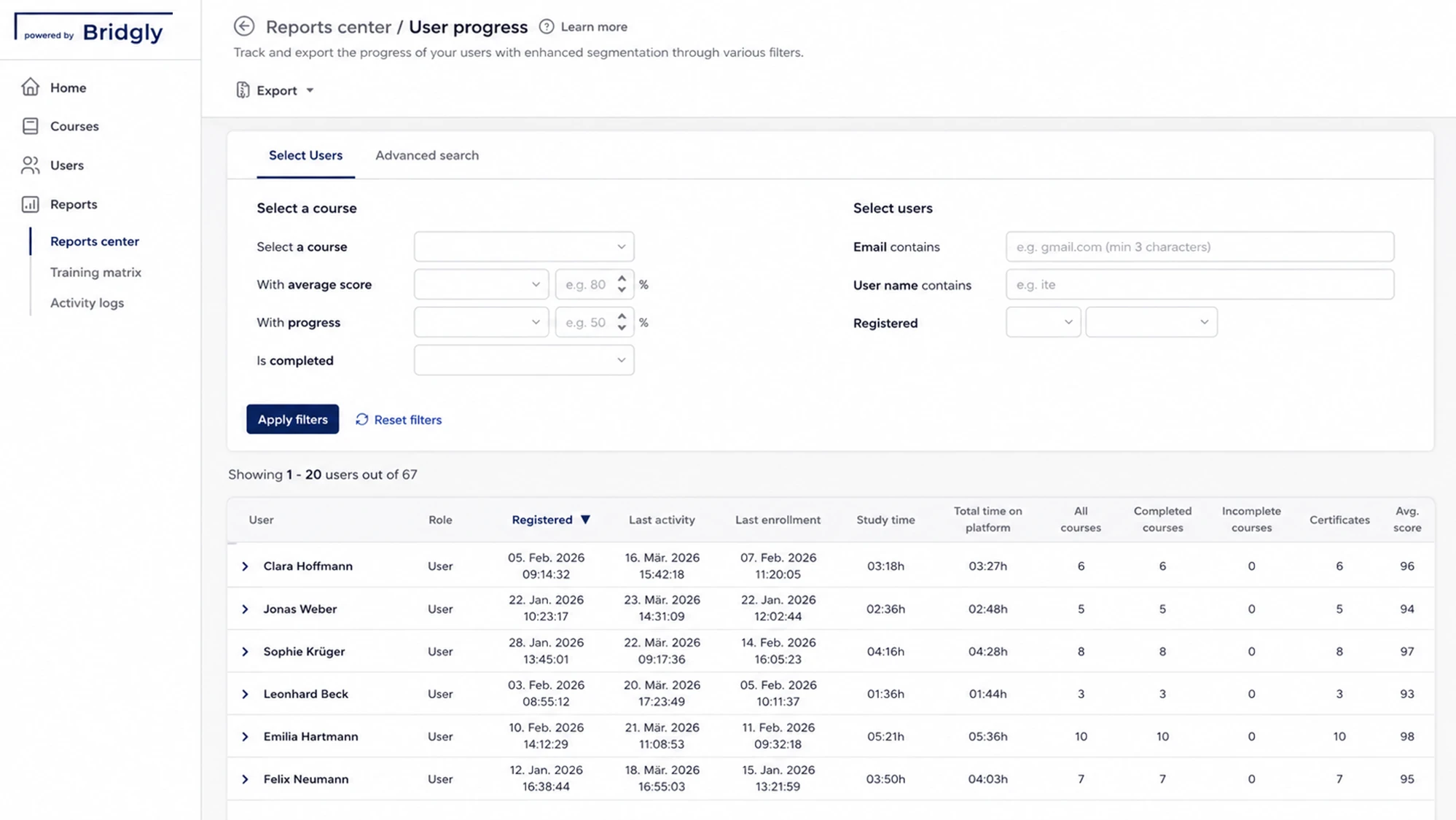
Our platform bundles all training management functions, from planning to reporting, in one place.
Training organization
Define who is trained on which content and when.
Training documentation
See at any time who completed which content and when.
Manage participants
CSV import, learning groups, and access rights in one place.
Automated
reminders
Deadlines and recurring training run automatically.
Here you will find the most important answers.
In Germany, companies of all sizes are subject to several training and instruction obligations. The most important: Occupational health and safety — Section 12 of the Occupational Health and Safety Act (ArbSchG), annually under Section 4 DGUV Regulation 1; Fire protection — Technical Rules for Workplaces (ASR A2.2), annually; Data protection — indirectly via Article 32 and Article 39 (1) lit. b GDPR; Equal treatment — Section 12 of the General Act on Equal Treatment (AGG); Whistleblower protection — obligation to provide information about the reporting offices under the Act for the Better Protection of Whistleblowers (HinSchG). Depending on the industry, further obligations apply, such as the instruction under Section 6 (2) no. 6 of the German Money Laundering Act (GwG) for obliged entities. Particularly noteworthy is Section 12 (2) sentence 2 AGG: if the employer has trained its employees in a suitable manner to prevent discrimination, this is deemed to fulfill its obligations under subsection 1. This is one of the few provisions that expressly recognizes training as fulfilling an obligation.
No. Neither the ArbSchG nor the relevant accident prevention regulations prescribe a specific format. What is required is sufficient, appropriate, and workplace-specific instruction — not a specific channel. Digital instruction is permissible if three conditions are met: the content is tailored to the specific activity, a learning assessment takes place, and participation is documented in a traceable manner. The option to ask questions of a competent person is recommended. One exception remains: for safety-critical activities — for example on dangerous machinery or when handling hazardous substances — supplementary practical instruction at the workplace is still necessary.
The consequences differ depending on the area of law, and they rarely consist of a direct fine. Occupational health and safety: In the event of an accident, there is a risk of civil liability, recourse claims by the accident insurance institution, and criminal investigations for negligent bodily injury. The route to fines runs via Section 209 (1) no. 1 SGB VII, up to 10,000 euros. Data protection: The supervisory authority regards missing training as a violation of Article 32 GDPR — range of fines under Article 83 (4): up to 10 million euros or 2% of worldwide annual turnover. Equal treatment: Without training, the route to exoneration under Section 12 (2) sentence 2 AGG is lost; claims for compensation and damages may follow. Money laundering: Violations of the instruction obligation are subject to fines in their own right. Added to this in all cases are reputational damage and questions of insurance coverage.
At least annually — this is the benchmark that most obligations are based on. In occupational health and safety, the interval results from Section 4 DGUV Regulation 1, in fire protection from ASR A2.2; for data protection and information security, supervisory authorities and the standards ISO/IEC 27001 and BSI Grundschutz recommend the same cycle. In addition, instruction must be provided whenever someone joins, before work begins. Further dates are added as occasions arise: in the event of significant legal changes, changed work procedures, new work equipment or substances, after incidents, and upon transfer to another workplace. The practical reason for the annual cycle is not only legal: content becomes outdated, and memory fades.
Companies with, as a rule, at least 50 employees must set up and operate an internal reporting office and inform their employees about how to reach it and how it works, as well as about the protective rights of whistleblowers. The Act does not contain an explicit training obligation. In practice, however, documented instruction can hardly be dispensed with: without it, it cannot be proven that the legally required publication of the reporting channels has actually taken place. The range of fines is tiered (Section 40 HinSchG): anyone who, contrary to Section 12 (1) sentence 1, fails to set up an internal reporting office can be fined up to 20,000 euros. The frequently cited 50,000 euros apply to other offenses — for example obstructing a report or retaliation against whistleblowers.
Four points. Professional responsibility: Each training course is designed and updated by named experts — lawyers, data protection officers, compliance officers. With many providers, it remains unclear who is accountable for the content. Effectiveness: The training courses have a multimodal structure — interactive learning elements, video sequences, and an integrated knowledge test instead of pure text modules. Effort: Getting started requires neither scheduling nor an IT project. Participation is documented automatically and in an audit-ready manner. Tailoring: Company-specific policies, internal reporting offices, and named contact persons can be integrated so that the content becomes concrete for employees instead of remaining general. The Legal & Compliance area comprises 21 training courses that can be booked individually or as a package.
Training and professional development for companies and public-sector clients – with audit-proof documentation and a practical focus.
Get in touch nowNote: Some text, images, and videos on this website were generated using artificial intelligence.

All content is for informational purposes and has been carefully reviewed from a journalistic perspective, but does not claim to be exhaustive or legally binding.