Google Gemini can be used productively and safely in day-to-day work in Gmail, Docs, Sheets, and Meet. You learn the basics of prompting and the rules for data protection-compliant use.

55 min
Multimodal
Über 30 Sprachen
Teilnahmebescheinigung
Google Gemini is deeply integrated into Google Workspace, which puts it just a click away for many employees: in Gmail, Docs, Sheets, Slides, and Meet. Without basic knowledge, however, unusable results, overlooked errors, or data protection violations caused by pasting in confidential information quickly arise. Anyone who knows how the model works, what makes a good prompt, and where the model's limits lie saves time and works safely.
00 Fundamentals: How Gemini works
01 Prompting basics
02 Gemini in Google Workspace
03 Checking and improving results
04 Data protection and safe use
05 Summary
06 Knowledge check incl. certificate of completion
All employees who want to integrate Google Gemini effectively and safely into their day-to-day work, from beginners to experienced users.
Leading organizations trust Bridgly
.png)

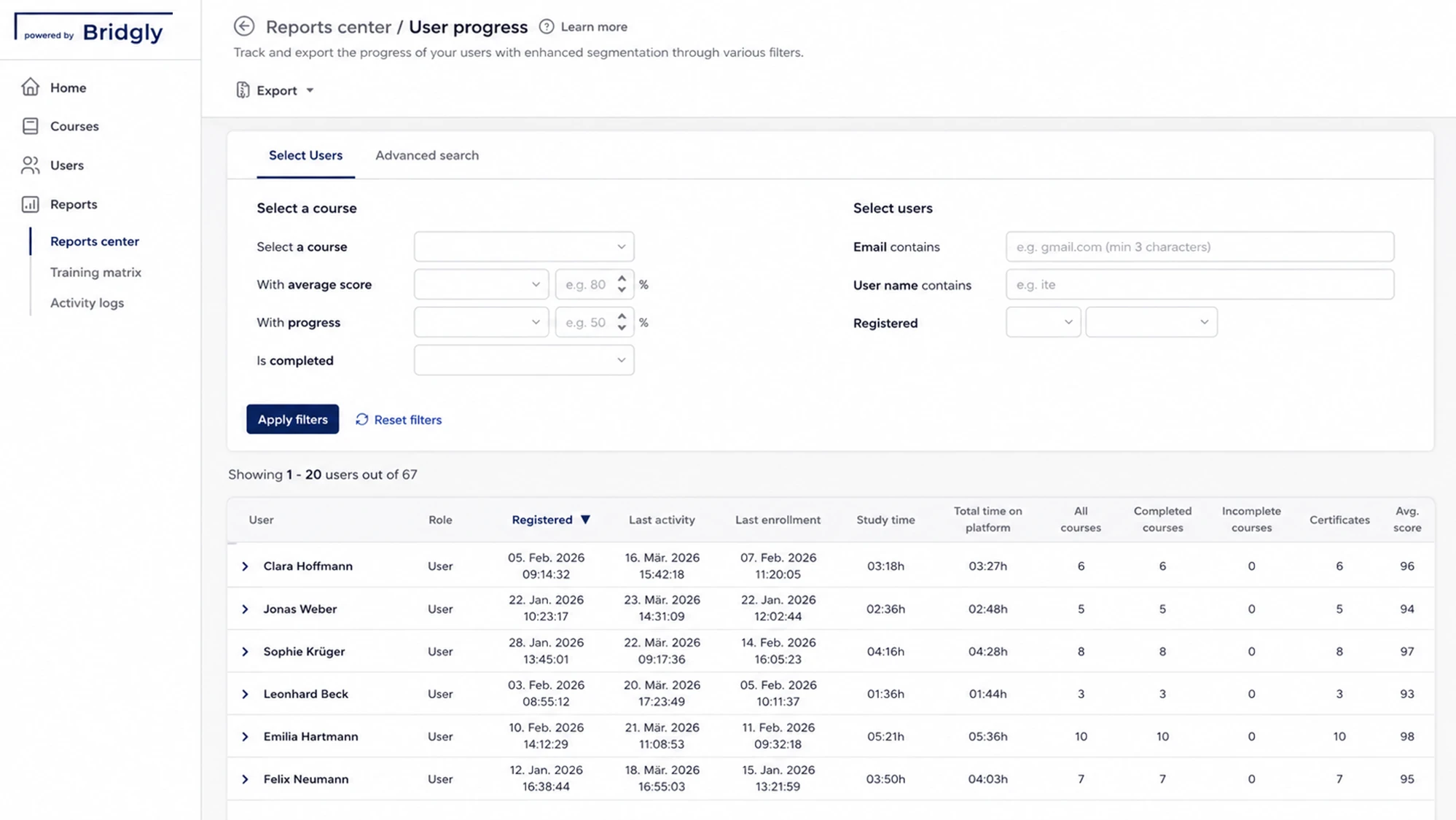
Our platform bundles all training management functions, from planning to reporting, in one place.
Training organization
Define who is trained on which content and when.
Training documentation
See at any time who completed which content and when.
Manage participants
CSV import, learning groups, and access rights in one place.
Automated
reminders
Deadlines and recurring training run automatically.
Here you will find the most important answers.
Article 4 of the EU AI Act (Regulation (EU) 2024/1689) requires providers and deployers of AI systems to take measures that support the development of their staff's AI literacy. The obligation has applied directly in all EU member states since February 2, 2025. Since July 27, 2026, Article 4 has applied as amended by Regulation (EU) 2026/1744. It expressly clarifies that the provision does not require providers and deployers to guarantee a specific level of AI literacy for any individual. What was previously often claimed to be an obligation to achieve a result has thus become an obligation to promote and support. What matters is tailoring: the measures should take into account prior technical knowledge, experience, education, and the context in which the AI systems are used. The Regulation does not prescribe any particular training format.
The obligation applies to the company, not to the individual. Article 4 of the EU AI Act requires providers and deployers to take measures for their staff and for other persons dealing with the operation and use of AI systems on their behalf. The Regulation does not provide for an obligation of individual employees to participate. The group is therefore broad: it extends beyond development and IT and covers everyone who uses AI tools in their day-to-day work or oversees their use — for example in marketing, HR, sales, or administration. The depth of the measures depends on role and context of use. Those who use AI occasionally need awareness raising; those who work with high-risk systems or are responsible for AI-supported decisions need more.
The EU AI Act does not provide for a separate fine for a violation of Article 4 itself. The catalog of fines in Article 99 (4) conclusively lists the sanctioned obligations — Article 4 is not among them. The German act implementing the EU AI Act does not mention it either. Other violations are sanctioned: prohibited AI practices with up to 35 million euros or 7% of worldwide annual turnover, whichever is higher (Article 99 (3)); violations of key provider and deployer obligations with up to 15 million euros or 3% (paragraph 4); incorrect information provided to authorities with up to 7.5 million euros or 1% (paragraph 5). For small and medium-sized enterprises, the lower amount applies in each case (paragraph 6). The real risk of a lack of AI literacy lies elsewhere: in the event of an AI-related data protection incident, a discriminatory decision, or a security problem, the GDPR, the General Act on Equal Treatment (AGG), and general liability law apply — with their own, often more serious consequences.
The Regulation takes effect in stages. Since February 2, 2025, Chapters I and II have applied — including Article 4 on AI literacy and the prohibited AI practices. Since August 2, 2026, the remainder of the Regulation has applied, in particular the transparency obligations under Article 50: AI systems that interact with people must identify themselves as such, and AI-generated content must be labeled in a machine-readable format. The obligations for high-risk systems were postponed by Regulation (EU) 2026/1744: they apply from December 2, 2027 for systems under Annex III and from August 2, 2028 for high-risk AI in regulated products under Annex I. The reason for the postponement is that the harmonized standards are not yet available. For organizations that use AI tools, the decisive date is therefore above all the one that has already passed: the obligation to promote AI literacy has existed since February 2025.
The EU AI Act defines AI literacy in Article 3 no. 56 as the skills, knowledge, and understanding that enable the informed use of AI systems and create awareness of opportunities, risks, and possible harm. This results in four areas: Technical fundamentals — how AI works, its limitations, and typical errors such as fabricated content and systematic bias; Legal framework — obligations under the EU AI Act, risk classes, transparency obligations under Article 50; Responsible use — human oversight, traceability, handling of results; Everyday application — safe inputs, handling of personal data, internal AI policies. Recital 20 of the Regulation requires the level to be adapted to role and context of use. In practice, the overlaps with data protection, copyright, and trade secrets come on top — AI use rarely takes place in isolation from these areas.
The standard training course takes around 30 minutes and covers the fundamentals addressed by Article 4 of the EU AI Act. Those looking for a more compact introduction choose the shortened training; those who want to go deeper choose the in-depth professional development course of around 2.5 hours. We recommend the 30-minute version because it combines solid competence with little organizational effort. All training courses have a multimodal structure — short video sequences, interactive learning elements, and an integrated knowledge test with automatic proof of participation. The content is designed by subject matter experts, is available in more than 30 languages, and can be supplemented with company-specific AI policies and use cases.
Training and professional development for companies and public-sector clients – with audit-proof documentation and a practical focus.
Get in touch nowNote: Some text, images, and videos on this website were generated using artificial intelligence.

All content is for informational purposes and has been carefully reviewed from a journalistic perspective, but does not claim to be exhaustive or legally binding.