In everyday work, electric current poses hazards that are fatal even at low current levels. You learn to recognize sources of danger and to respond correctly to electrical accidents.

25 min
Multimodal
Über 30 Sprachen
Teilnahmebescheinigung
Electric current is invisible, silent, and fatal even at low current levels. Defective cables, improper repairs, moisture, and unauthorized persons opening distribution boards lead to fatal accidents and fires every year. DGUV Regulation 3 and the Ordinance on Industrial Safety and Health (BetrSichV) require all employees to know the hazards and to leave work on electrical installations exclusively to qualified electricians.
00 Fundamentals: effects of electric current
01 Sources of danger in everyday work
02 Safety rules and responsibilities
03 Protective measures and testing
04 Behavior in electrical accidents
05 Summary
06 Knowledge check incl. certificate of completion
The entire workforce that needs to protect itself from the hazards of electric current in everyday work; modular and suitable as initial training for new employees and as an annual refresher.
Leading organizations trust Bridgly
.png)

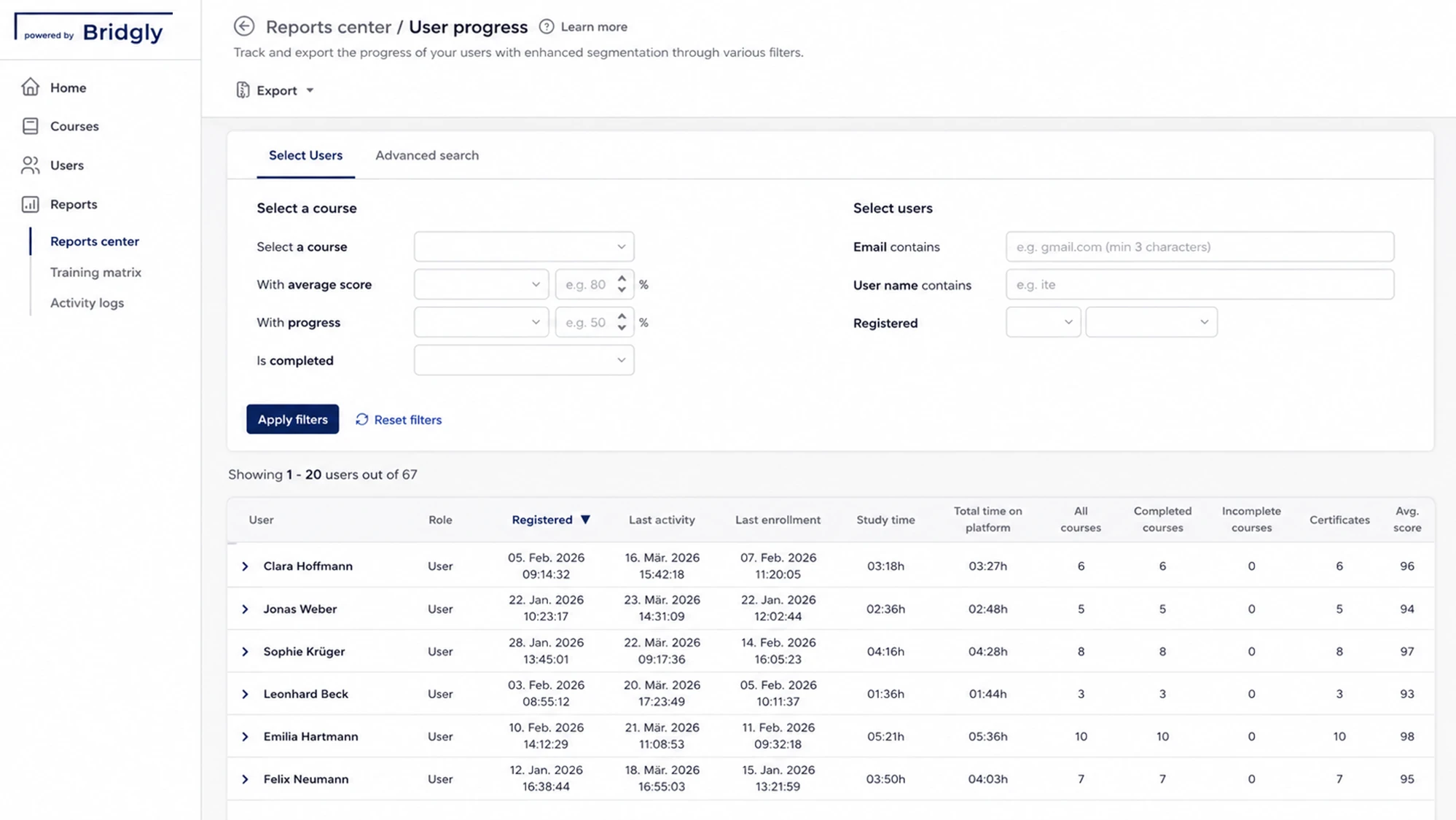
Our platform bundles all training management functions, from planning to reporting, in one place.
Training organization
Define who is trained on which content and when.
Training documentation
See at any time who completed which content and when.
Manage participants
CSV import, learning groups, and access rights in one place.
Automated
reminders
Deadlines and recurring training run automatically.
Here you will find the most important answers.
At least once a year. Section 12 (1) of the Occupational Health and Safety Act (ArbSchG) requires "sufficient and appropriate" instruction; the annual interval results from Section 4 DGUV Regulation 1, the accident prevention regulation of the statutory accident insurance. In addition, instruction must be provided as occasions arise: before work begins for new hires, upon transfer to another workplace, when new work equipment, procedures, or substances are introduced, and after accidents and near misses. Two requirements determine its effectiveness: the instruction must be specific to the workplace and the activity, and it must be documented. From the perspective of authorities and courts, undocumented instruction is deemed not to have taken place in the event of a dispute.
Fire safety instruction must enable employees to prevent fires and to act correctly in an emergency. The legal bases are the ArbSchG and the Technical Rule for Workplaces (ASR A2.2). The content includes: fire hazards in the company and fire classes; behavior in the event of fire and making an emergency call; escape and rescue routes, assembly points; operating fire extinguishers and wall hydrants; evacuation procedures and the role of fire wardens. The instruction must be repeated at least annually and tailored to the specific conditions of the company. The fire safety regulations according to DIN 14096 are a suitable basis for the content.
The consequences lie less in fines than in liability. Under civil law, the employer may lose its right of recourse against employees and be liable for damages. Under criminal law, serious accidents can lead to investigations for negligent bodily injury or negligent homicide, with personal responsibility on the part of management. When it comes to fines, it is worth taking a closer look: failure to provide instruction is not a separate offense under Section 25 ArbSchG — this provision applies to violations of statutory ordinances or enforceable orders of the supervisory authority and then provides for fines of up to 5,000 euros, and up to 30,000 euros in the cases of subsection 1 no. 2. The relevant route for the instruction obligation is Section 209 (1) no. 1 SGB VII — violation of an accident prevention regulation, fine of up to 10,000 euros. Added to this are recourse claims by the accident insurance institution and questions of insurance coverage.
Yes, provided it meets the content-related and formal requirements. Neither the ArbSchG nor DGUV Regulation 1 prescribes a specific format — what is required is sufficient and appropriate instruction that is specific to the workplace and the activity. This results in three conditions for digital formats: the content must be tailored to the specific activity, a learning assessment must take place, and participation must be documented in a traceable manner. In addition, the option to ask questions of a competent contact person is recommended. One limit remains: for safety-critical activities — for example operating dangerous machinery or working with hazardous substances — supplementary practical instruction at the workplace is still required. Digital instruction does not replace it; it prepares for it.
Yes. Section 12 (1) ArbSchG expressly requires instruction that relates to the employees' workplace or area of responsibility. A uniform standard instruction for the entire workforce does not meet this requirement. The basis for differentiation is the risk assessment under Section 5 ArbSchG: it identifies the activity-specific hazards from which the training needs are derived. An employee in the office needs different content than an employee in the warehouse, in field service, or in production. Managers bear additional obligations: under Section 13 ArbSchG, they are responsible for implementation within the scope of their tasks — under Section 13 (2), delegating duties requires that the appointed person is reliable and competent. In the event of damage, blanket instruction is regularly assessed as insufficient.
The area comprises 48 online training courses, making it the largest in the catalog. It covers the annual mandatory topics as well as activity-specific training. In general occupational health and safety: employer obligations, workplace hazards, ergonomics, personal protective equipment, handling hazardous substances, lifting and carrying, first aid, and behavior in emergencies. In fire safety: fire classes, fire prevention, escape and rescue routes, fire extinguishers, emergency calls, and evacuation. In addition, there is activity-specific training, for example for industrial trucks, cranes, earthmoving machinery, lone working, and working on machines. The content has a modular structure and can be put together according to role and workplace. It is available in more than 30 languages and can be supplemented with company-specific information such as escape routes, assembly points, emergency numbers, and contact persons.
Training and professional development for companies and public-sector clients – with audit-proof documentation and a practical focus.
Get in touch nowNote: Some text, images, and videos on this website were generated using artificial intelligence.

All content is for informational purposes and has been carefully reviewed from a journalistic perspective, but does not claim to be exhaustive or legally binding.