
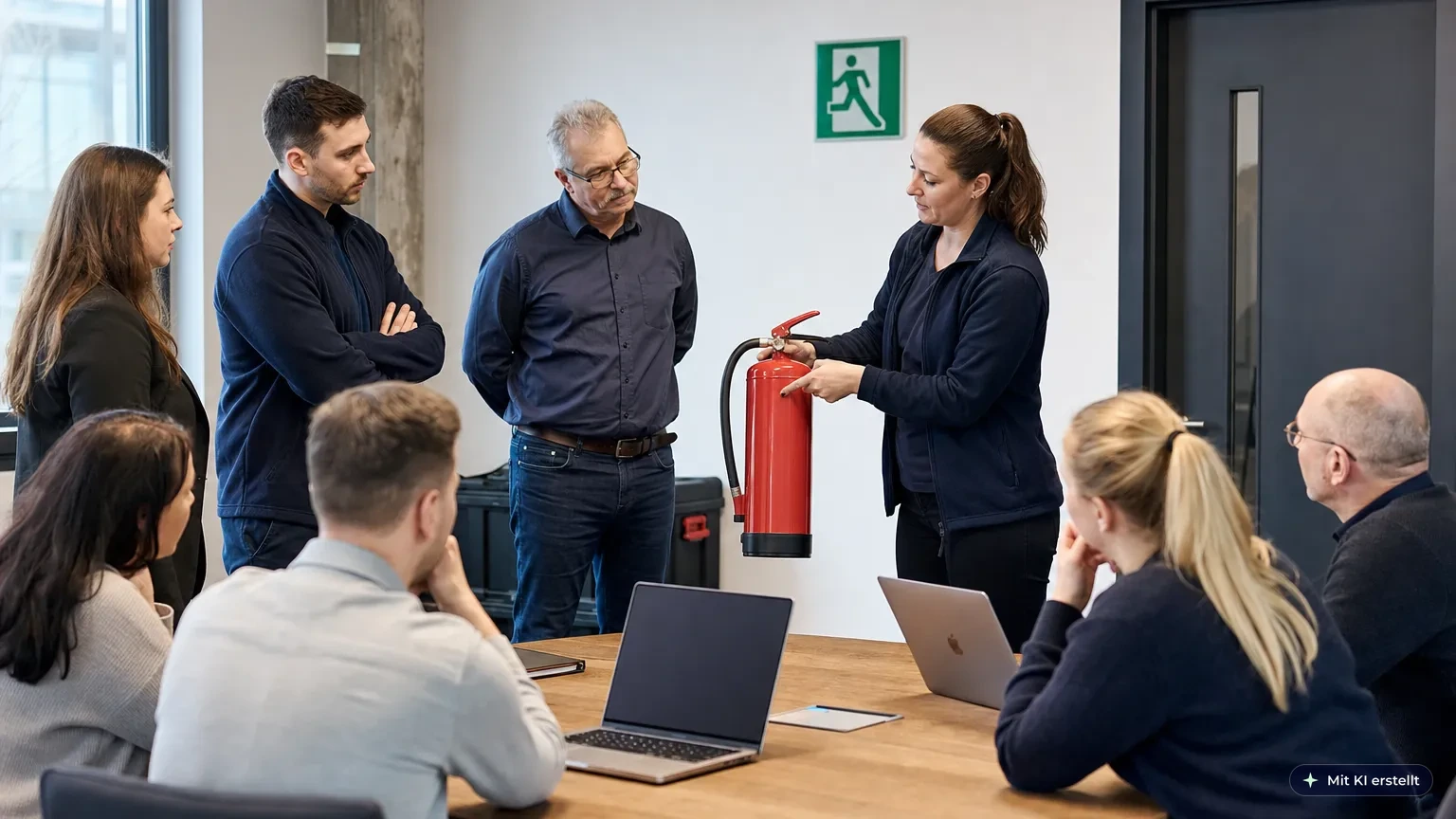
Fire safety instruction is mandatory at least once a year. Initial instruction must take place before work begins; after that, it must be repeated regularly – at least once a year. This obligation follows from Section 12 of the Occupational Health and Safety Act (ArbSchG) in conjunction with Section 4 of DGUV Regulation 1 and the Technical Rule for Workplaces ASR A2.2 „Maßnahmen gegen Brände“.
Annual repetition is the rule, not the upper limit. As soon as hazards, work processes, or the company's fire protection organization change, instruction must be given earlier on an event-driven basis. Limit/exception: A general extension of the interval beyond one year is not permitted for general fire safety instruction – the fixed annual interval applies regardless of company size.
Fire safety instruction is part of workplace occupational health and safety and specifies the general duty to provide instruction under Section 12 ArbSchG for fire protection; the specific content and intervals follow from the risk assessment. The topic hub Occupational Safety & Fire Protection brings together further articles.
The binding annual interval rests on three sets of rules that build on one another. Section 12 ArbSchG obliges the employer to give employees "sufficient and appropriate" instruction – before they take up their work, when their area of responsibility changes, and when new work equipment or technologies are introduced. The act itself does not specify a fixed number but requires repetition adapted to how the hazards develop. The ASR specify the Workplace Ordinance (ArbStättV) in more detail; anyone who complies with them can assume that they meet the corresponding requirements of the ordinance (presumption of conformity).
Only Section 4 of DGUV Regulation 1 turns this into a binding minimum interval: instruction must be repeated "where necessary", but at least once a year, and it must be documented. For fire protection, ASR A2.2 expressly confirms this standard – under section 7.2, all employees must be instructed on the fire protection measures laid down "before they take up employment, when their area of activity changes, and thereafter at appropriate intervals, but at least once a year".
Limit/exception: The "but at least once a year" and the documentation requirement belong to Section 4 DGUV Regulation 1, not to Section 12 ArbSchG – the act provides the basic duty, the sub-statutory rules the fixed interval. In the case of an increased fire hazard or significant operational changes, the risk assessment may require shorter intervals.
Fire safety instruction has three triggers that complement one another. Initial instruction takes place before work begins – new employees may not go to their workplace without instruction. Repeat instruction then takes place at least once a year and keeps knowledge up to date. Event-driven instruction is added as soon as something relevant to safety changes.
Typical occasions are new work equipment or work processes with a changed fire hazard, a move or conversion, changed escape and rescue routes, or an incident involving damage. Limit/exception: Event-driven instruction does not replace annual repetition – the two run side by side. For young people under 18, a shorter mandatory interval also applies: under Section 29 JArbSchG, instruction on hazards must be repeated at least every six months.
All employees must be instructed – regardless of function, scope of employment, or fixed-term status. ASR A2.2 expressly obliges the employer to instruct "all employees" on the fire protection measures laid down. This also includes part-time staff, interns, working students, and short-term employees; there is no de minimis threshold based on hours worked. For visitors and external contractors, instead of full instruction it is as a rule sufficient to post the fire protection and conduct rules in an easily accessible place or to provide them as Part A of the fire safety regulations (ASR A2.2, section 7.1).
In the case of temporary agency work, the duty to provide instruction under Section 12 (2) ArbSchG lies with the hirer, i.e., the company where the workers are deployed – it knows the specific hazards on site. Limit/exception: This must be distinguished from the additional training of fire wardens, which concerns only part of the workforce.
The content depends on the risk assessment and the company's fire protection measures under ASR A2.2. At its core, it is about prevention, correct behavior in the event of a fire, and the use of the extinguishing equipment available. Four topic blocks can be distinguished for orientation:
The third amendment to ASR A2.2 (GMBl 2025) sharpened individual points: the terminology was changed from "clearance drill" (Räumungsübung) to "evacuation drill" (Evakuierungsübung), and the expert instruction of fire wardens now expressly covers the handling of all fire extinguishing equipment available – for example, fat fire extinguishers or wall hydrants as well. Organizationally, fire safety regulations according to DIN 14096 (Parts A, B, and C) can support the instruction. The measures laid down must be documented and made accessible to all employees – for example, as Part B of the fire safety regulations (ASR A2.2, section 7.1).
Limit/exception: General fire safety instruction does not replace the special fire warden training with a practical extinguishing exercise.
The number of fire wardens follows from the risk assessment; according to ASR A2.2, a share of as a rule 5% of employees is sufficient where the fire hazard is normal. In areas with an increased fire hazard, many persons present, persons with limited mobility, or a large spatial extent, a higher share may be necessary. Shift work, vacation, and illness must be factored in. The fire warden must be distinguished from the fire safety officer, whose appointment may result primarily from an increased fire hazard or from state-law requirements.
Fire wardens receive expert instruction; this includes the basic principles of preventive fire protection, the company's fire protection organization, the function and effect of fire extinguishing equipment, and practical extinguishing exercises. For the refresher, ASR A2.2 in its 2025 version gives an interval proven in practice of two to five years; DGUV Information 205-023 „Brandschutzhelfer“ (edition 11/2019) recommends three to five years. Both figures are expressly recommendations; the employer sets the specific interval on the basis of the risk assessment.
Limit/exception: The 5% is a guideline value, not a rigid upper limit. The multi-year refresher interval applies only to fire warden training, not to the annual general instruction of the entire workforce.
Yes. Under Section 4 DGUV Regulation 1, every instruction must be documented so that the employer can provide proof. The template in DGUV Rule 100-001 „Grundsätze der Prävention“ serves as orientation for which details a record should contain: company and work area, person conducting the instruction and their function, date, type of instruction (initial, repeat, or event-driven instruction), the content of the instruction, and participation.
DGUV Regulation 1 does not prescribe a specific form – digital records are also permitted, and a signature is not mandatory. Limit/exception: If there is no documentation, the instruction is in practice deemed not to have been carried out in the event of a dispute or inspection – regardless of whether it actually took place. Documentation is therefore the employer's central exculpatory document. It should be traceable and retrievable over the usual retention periods so that past instruction can be proven in the event of an inspection.
Annual fire safety instruction can in principle be implemented digitally – for example, as e-learning via a learning management system (LMS). The revised DGUV Rule 100-001 (edition 06/2025) treats electronic aids as a regular form of instruction but attaches conditions to them: the person responsible must make sure that the content has been understood, there must be an opportunity to ask questions, and pure self-study without a knowledge check is not sufficient.
In practice, this means that digital fire safety instruction needs workplace-specific content, a comprehension or knowledge check, and reliable proof of participation. Because instruction must be given "in an understandable form and language" (DGUV Rule 100-001), multilingualism and an accessible presentation are a real criterion for mixed workforces. The requirements a system should meet for this are covered in the article on choosing an LMS for mandatory training. Limit/exception: Purely practical components – above all the extinguishing exercise for fire wardens – cannot be delivered digitally alone; a documented in-person or practical component remains necessary here. For this practical component – the extinguishing exercise as part of fire warden training – DGUV Rule 100-001 stipulates that electronic learning media may only supplement it, not replace it. The general annual fire safety instruction of the workforce remains unaffected by this and can take place digitally under the conditions set out above.
This article is based exclusively on German primary sources: the ArbSchG (gesetze-im-internet.de), DGUV Regulation 1 „Grundsätze der Prävention“, DGUV Rule 100-001, ASR A2.2 „Maßnahmen gegen Brände“ (BAuA), and DGUV Information 205-023 „Brandschutzhelfer“. The authoritative version is ASR A2.2 as last amended (third amendment, GMBl 2025, p. 365, of May 23, 2025). All standards, deadlines, and frequencies were checked against the primary sources on April 13, 2026. The specific determination in the individual company is always made via the company risk assessment. As of 13 Apr 2026.
At least once a year. This follows from Section 12 ArbSchG in conjunction with Section 4 DGUV Regulation 1 and ASR A2.2. Initial instruction is necessary before work begins, followed by annual repetition. If hazards change, instruction must be given earlier on an event-driven basis. The year is the minimum standard, not an upper limit.
Yes. The obligation follows from Section 12 ArbSchG, specified by Section 4 DGUV Regulation 1 and ASR A2.2 „Maßnahmen gegen Brände“. Fire safety instruction is therefore not a voluntary offering but a verifiable employer obligation with a fixed minimum interval.
All employees, regardless of function or scope of employment – including part-time staff, interns, and fixed-term employees. In the case of temporary agency work, the obligation under Section 12 (2) ArbSchG lies with the hirer. Separate from this is the additional training of fire wardens (as a rule around 5 percent).
The number follows from the risk assessment; according to ASR A2.2, a share of as a rule 5 percent of employees is sufficient. Where the fire hazard is increased or many persons are present, more may be required. Shift work, vacation, and illness must be factored in.
The practical refresher should take place at intervals of several years: ASR A2.2 (2025 version) recommends two to five years, the older DGUV Information 205-023 (11/2019) three to five years. The employer sets the exact interval on the basis of the risk assessment. It applies only to the fire warden refresher – general instruction remains mandatory every year.
Yes, under Section 4 DGUV Regulation 1, every instruction must be documented. A list of participants with the date, content, signatures, and name of the person giving the instruction is customary. No specific form is prescribed; digital records are also permitted. Without documentation, the instruction is in practice deemed not to have been carried out in the event of a dispute.
All standards, deadlines, and frequencies were checked against the primary sources on 13 Apr 2026. The frequency figures for the fire warden refresher (ASR A2.2: 2–5 years; DGUV Information 205-023: 3–5 years) are expressly recommendations; the employer sets the interval on the basis of the risk assessment. Image: AI-generated (Bridgly), labeled "Created with AI" (Art. 50 EU AI Act) – image asset still in production.
Insights into the future of digital learning, with a focus on AI, compliance, and modern training solutions. Discover the latest posts and articles to gain practical insights into legally compliant, efficient, and automated corporate training.
Bridgly is the European training partner for audit-proof, tailored, and automated training and professional development.
 We support the IHK initiative "Pack ma's digital" to help businesses in Upper Bavaria with digitalisation and secure the future of the region.
Note: Some text, images, and videos on this website were generated using artificial intelligence.
All content is for informational purposes and has been carefully reviewed from a journalistic perspective, but does not claim to be exhaustive or legally binding.
.webp)