Auditors must assess the adequacy and the effectiveness of money laundering prevention separately. You learn to evaluate findings and to write convincing audit reports.

55 min
Multimodal
Über 30 Sprachen
Teilnahmebescheinigung
Adequacy and effectiveness are the central audit benchmarks under Section 6 of the German Money Laundering Act (GwG) and the AMLR: Is the system conceptually suited to cover the company's risks, and does it actually work in day-to-day operations? Auditors must assess both separately, from the risk analysis through customer due diligence and monitoring to reporting. Findings without clear criteria, a materiality assessment, and traceable evidence are not accepted by senior management and the supervisory authorities.
00 Audit benchmarks: adequacy and effectiveness
01 Auditing the design
02 Auditing effectiveness
03 Findings, materiality, and follow-up
04 Reporting to senior management and the supervisory authorities
05 Summary
06 Knowledge check incl. certificate of completion
Internal audit, audit managers, and external auditors who audit the money laundering prevention of obliged entities.
Leading organizations trust Bridgly
.png)

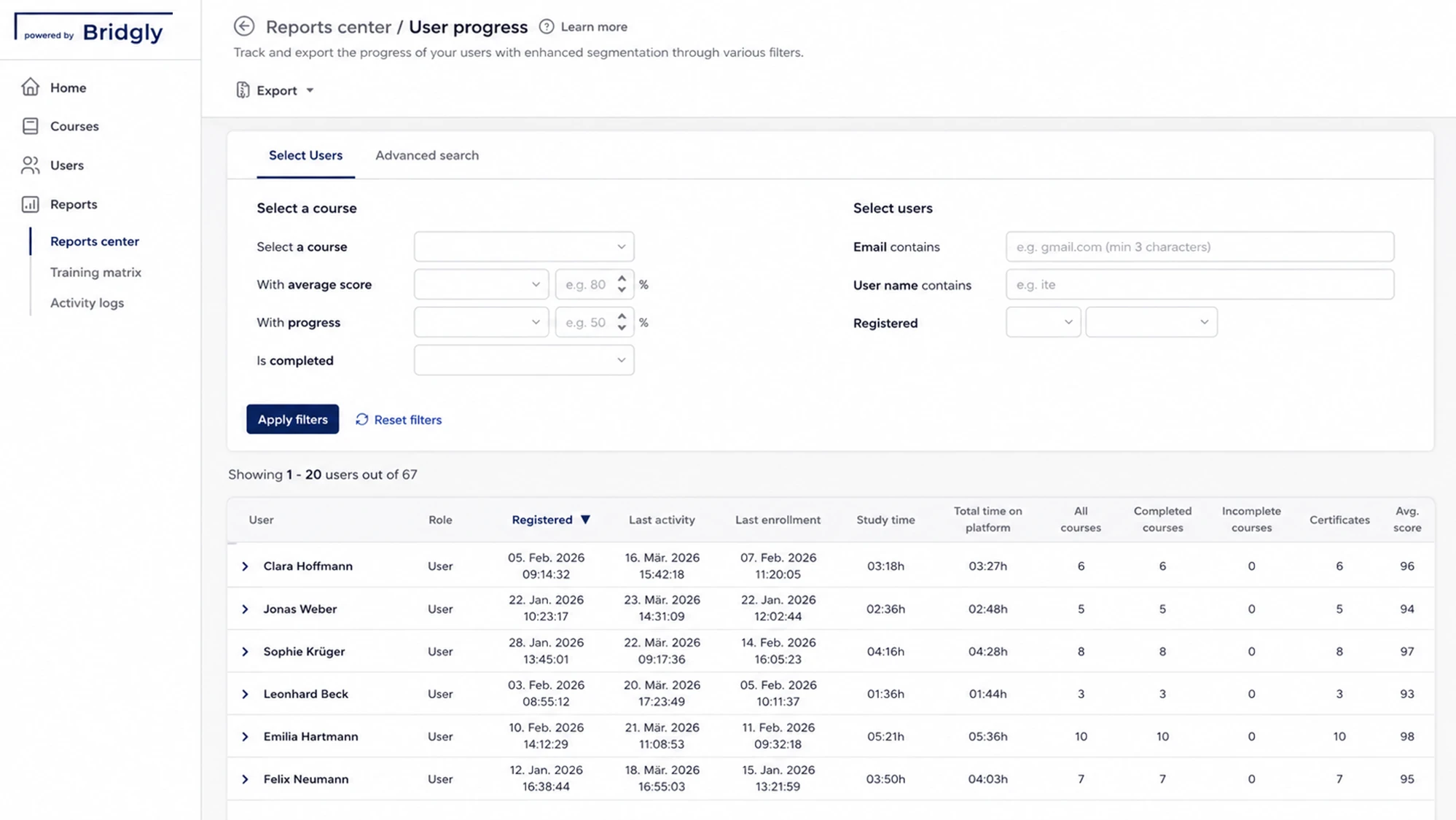
Our platform bundles all training management functions, from planning to reporting, in one place.
Training organization
Define who is trained on which content and when.
Training documentation
See at any time who completed which content and when.
Manage participants
CSV import, learning groups, and access rights in one place.
Automated
reminders
Deadlines and recurring training run automatically.
Here you will find the most important answers.
All "obliged entities" within the meaning of Section 2 GwG. Section 6 (2) no. 6 GwG requires them to regularly instruct their employees on methods of money laundering and terrorist financing and on the applicable obligations. Obliged entities include, among others, credit institutions, insurance companies, financial services providers, tax advisors, auditors, lawyers and notaries in certain activities, real estate agents, trustees, crypto-asset service providers, gambling providers, and traders in goods for cash payments of 10,000 euros or more — for precious metals from as little as 2,000 euros. The obligation covers all employees involved in business processes relevant to money laundering: not only compliance, but also client advisory, sales, and management. Responsibility for implementation usually lies with the AML officer to be appointed under Section 7 GwG.
Regulation (EU) 2024/1624 applies directly in all member states from July 10, 2027 — without a national transposition act. Together with the 6th Anti-Money Laundering Directive, it replaces the previous system, which was heavily driven by interpretation. For companies, this means four shifts: uniform obligations throughout the EU instead of national arrangements, direct applicability instead of transposition through national law, closer supervision by the new European authority AMLA based in Frankfurt am Main, and significantly higher requirements for risk management, documentation, and training. The core of the reform is a change of yardstick: in the future, compliance will no longer be measured by policies and descriptions, but by structured, reproducible, and verifiable data.
The framework is tiered according to the group of addressees. For credit and financial institutions, the rules provide for fines of up to at least 10 million euros or 10% of total annual turnover, whichever is higher, for serious, repeated, or systematic violations. A different standard applies to the other obliged entities: up to at least twice the benefit derived from the violation, or up to at least 1 million euros. A missed or insufficiently documented training course has a double effect: it is a separate breach of duty and is additionally considered an aggravating factor if a suspicious case occurs that trained employees could have recognized and reported. In the future, AMLA will coordinate supervision centrally — violations will thus become visible across member state borders.
Ongoing and regular. Section 6 (2) no. 6 GwG requires "regular" instruction without specifying a fixed interval. In practice, an annual cycle has become established as the minimum standard. In addition, training must be provided when specific occasions arise: for new hires, before they take up activities relevant to money laundering; in the event of significant legal changes — for example the application of the AMLR from July 10, 2027; when internal policies are updated; after identified anomalies or suspicious cases. The new EU law raises the bar: training should be continuous, tailored to the respective function, and documented with a complete audit trail.
Training changes from a supporting measure to a control element of the prevention system. Obliged entities must ensure that their employees understand the risks, know the applicable rules, and are actually able to apply the internal policies. Three criteria shape the requirement: Continuity — ongoing instead of a one-off event; Function-specific focus — tailored to the role and the specific risk environment; Documentation with a complete audit trail — verifiable for the supervisory authority. Training is thus no longer purely an HR matter, but an auditable component of the internal control system — with direct significance for the supervisory assessment.
Four criteria are decisive: Professional responsibility — the content should come from named experts with practical experience in anti-money laundering law, not from anonymous standard production; Regulatory currency — the training must reflect the current legal situation as well as the transition to the AMLR from July 10, 2027; Function-specific focus — role-specific tailoring for management, AML officers, client advisory, sales, and compliance, which can be supplemented with internal policies; Proof — every participation with a timestamp, learning assessment, and exportable proof. The Anti-Money Laundering & Counter-Terrorist Financing area at Bridgly comprises 29 training courses: a foundational mandatory training course, industry-specific modules for the individual types of obliged entities, and in-depth courses for AML officers and internal audit.
Training and professional development for companies and public-sector clients – with audit-proof documentation and a practical focus.
Get in touch nowNote: Some text, images, and videos on this website were generated using artificial intelligence.

All content is for informational purposes and has been carefully reviewed from a journalistic perspective, but does not claim to be exhaustive or legally binding.