Conflicts in a team can be identified and classified by type of conflict and by escalation stage according to Glasl. You learn to resolve conflicts constructively using mediation techniques.

55 min
Multimodal
Über 30 Sprachen
Teilnahmebescheinigung
Unresolved conflicts cost companies productivity, sick days, and employees. Managers and teams often intervene too late or by putting their foot down, which drives conflicts underground. Mediation offers a structured procedure that focuses on interests rather than positions and, even without formal training, provides a basic attitude and tools for everyday use.
00 Fundamentals: Understanding conflicts
01 Mediation as a procedure
02 Phases of the conflict discussion
03 Mediation techniques
04 Limits and sustainability
05 Summary
06 Knowledge check incl. certificate of completion
Managers, team leaders, HR managers, and employees who mediate conflicts in the team.
Leading organizations trust Bridgly
.png)

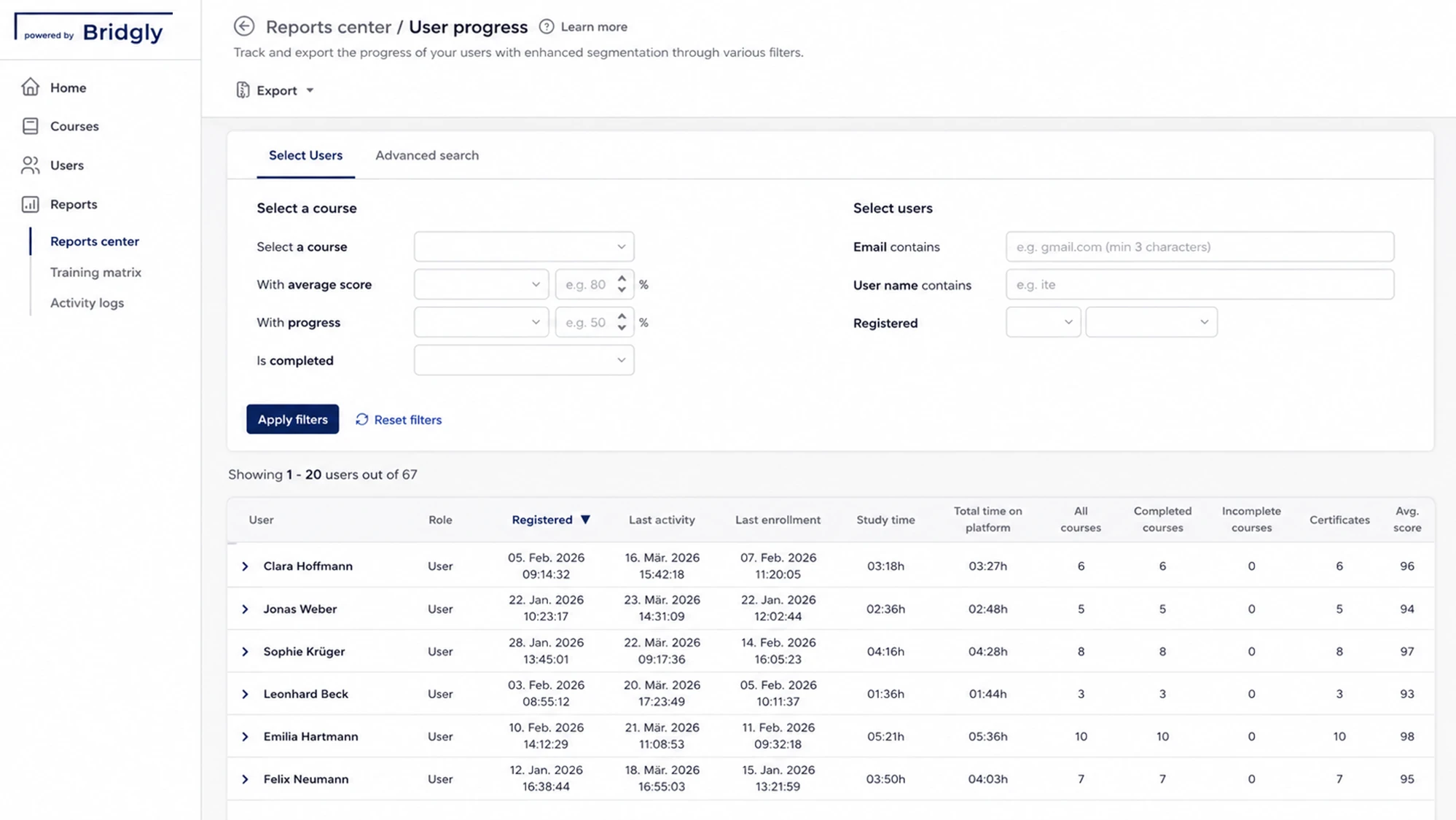
Our platform bundles all training management functions, from planning to reporting, in one place.
Training organization
Define who is trained on which content and when.
Training documentation
See at any time who completed which content and when.
Manage participants
CSV import, learning groups, and access rights in one place.
Automated
reminders
Deadlines and recurring training run automatically.
Here you will find the most important answers.
No – German law does not impose a general obligation to train employees in conducting conversations, presenting, or teamwork. At two points, however, these topics touch on genuine employer obligations. The first is Section 12 of the General Act on Equal Treatment (AGG). Under Section 12 (1) AGG, the employer must take the necessary measures to protect against discrimination, including preventive measures. Section 12 (2) sentence 2 AGG attaches a legal consequence to this that is central in practice: if the employer has trained its employees in a suitable manner for the purpose of preventing discrimination, this is deemed to fulfill its obligations under subsection 1. Training is thus the means named in the Act itself for fulfilling the obligation. The second is the risk assessment under Section 5 of the Occupational Health and Safety Act (ArbSchG). There, subsection 3 no. 6 expressly names mental strain at work as a possible source of hazard, and no. 5 additionally names insufficient qualification and instruction of employees. For the other topics in this category – presenting, feedback, networking, intercultural collaboration – there is no legal obligation; training on them is provided for business reasons.
Questions that relate to one of the grounds listed in Section 1 AGG are inadmissible: race or ethnic origin, sex, religion or belief, disability, age, and sexual identity. The prohibition of discrimination in Section 7 (1) AGG also applies in the application process: Section 2 (1) no. 1 AGG expressly covers selection criteria and recruitment conditions, and Section 6 (1) sentence 2 AGG puts applicants on an equal footing with employees. Under Section 15 (2) AGG, a person who has been discriminated against can claim appropriate monetary compensation; in the case of non-hiring, this may not exceed three months' salary if the person would not have been hired even in a discrimination-free selection. In addition, there is a claim for damages under Section 15 (1) AGG. Under Section 15 (4) AGG, claims must be asserted in writing within two months, calculated from receipt of the rejection. Under Section 15 (6) AGG, a violation does not give rise to a claim to the position itself. It follows that questions that cannot be derived from the job requirements have no place in the interview. A fixed catalog of questions and an evaluation form make the decision traceable.
Yes – social relationships at work are one of six design areas of the risk assessment of mental strain. The legal basis is Section 5 (1) in conjunction with Section 5 (3) no. 6 ArbSchG, which names mental strain as a source of hazard. The GDA recommendations "Berücksichtigung psychischer Belastung in der Gefährdungsbeurteilung" (Consideration of Mental Strain in Risk Assessment) (4th edition 2022, Federal Ministry of Labour and Social Affairs) name the following design areas: work content and tasks, work organization, working time, social relationships at work, working environment conditions, and the use of work equipment. As hazardous conditions, they list, among other things, frequent disputes, conflicts, and violence, destructive behavior such as belittling, exclusion, discrimination, and harassment, a lack of social support, and – in the case of superiors – a lack of feedback and recognition. Two design objectives relate directly to qualification: rules for dealing with conflicts and mistakes – an open error culture – and sufficient time and qualification opportunities for managers to shape social relationships in the workplace in an appreciative way.
Psychological safety is the shared belief of the members of a team that the team is a safe place for interpersonal risks – in the original, "a shared belief held by members of a team that the team is safe for interpersonal risk taking." This refers to everyday risks: asking questions, admitting a mistake, raising concerns, disagreeing. The term was introduced by Amy Edmondson in 1999 in Administrative Science Quarterly (Volume 44, Issue 2, pp. 350–383). Her field study of 51 work teams in a manufacturing company found that psychological safety is associated with the team's learning behavior, whereas the team's efficacy beliefs are not; learning behavior mediates between safety and team performance. In practice, this means that psychological safety does not arise from appeals, but from concrete behavior in everyday work – how questions are responded to, how mistakes are discussed, whether there is room for concerns. The GDA recommendations on the risk assessment of mental strain (4th edition 2022) point in the same direction: they name as a design objective rules for dealing with conflicts and mistakes – an open error culture.
The phase model of escalation presented by conflict researcher Friedrich Glasl in 1980 classifies conflicts into nine escalation stages, divided into three main phases of three stages each. In the first main phase, both sides can still win (win-win); in the second, one side wins at the expense of the other (win-lose); in the third, both lose (lose-lose). Stages one to three range from the hardening of positions through debate and polemics to "actions, not words," when verbal communication breaks down. Between the main phases lie main thresholds: if the first is respected, a cooperative solution on the factual level remains possible; the second marks whether moral and ethical scruples still have an effect. The benefit of this classification: it determines the right time to intervene before a threshold is crossed. Mediation puts interests rather than positions at the center. It is based on voluntariness, multi-partiality, and confidentiality; the conflict discussion proceeds in phases from clarifying the mandate through topics, interests, and options to the agreement. Where your own mediation efforts reach their limits, external support must be brought in.
An online training course from the Communication & Teamwork category takes 55 minutes at Bridgly. The category comprises 19 courses on preparing and conducting conversations, presenting in person and in virtual settings, feedback, conflict management and mediation, error culture and psychological safety, knowledge transfer in succession, networking, and intercultural competence with dedicated courses on China, the USA, and the Arab states. Each course can be booked individually or as part of a package. The "Communication" package bundles 10 courses on conversations, presence, and presentation; the "Team & Collaboration" package bundles 9 courses on collaboration, feedback, conflicts, and intercultural teams. Together, all 19 courses add up to just over 17 hours of learning time. The courses have a multimodal structure, are available in more than 30 languages, and conclude with a learning assessment that documents completion. Content, design, and settings can be adapted to your own organization; for companies with their own learning management system, export as SCORM 1.2 or SCORM 2004 is available.
Training and professional development for companies and public-sector clients – with audit-proof documentation and a practical focus.
Get in touch nowNote: Some text, images, and videos on this website were generated using artificial intelligence.

All content is for informational purposes and has been carefully reviewed from a journalistic perspective, but does not claim to be exhaustive or legally binding.