
The Cyber Resilience Act imposes security requirements on hardware and software with digital elements throughout their entire life cycle. You learn how conformity assessment, reporting obligations, and CE marking work.

55 min
Multimodal
Über 30 Sprachen
Teilnahmebescheinigung
The Cyber Resilience Act (Regulation (EU) 2024/2847) makes cybersecurity a prerequisite for placing connected products on the market in the EU – from smart home devices and industrial controls to software. Manufacturers must demonstrate security by design, fix vulnerabilities during the support period, report actively exploited vulnerabilities to ENISA within 24 hours, and ensure full conformity from December 2027. Importers and distributors also have obligations; violations can be penalized with up to 15 million euros or 2.5% of turnover.
00 Fundamentals and scope of the CRA
01 Security requirements across the product life cycle
02 Vulnerability management and reporting obligations
03 Conformity assessment and CE marking
04 Obligations of economic operators and sanctions
05 Summary
06 Knowledge check incl. certificate of completion
Product managers, heads of development, product security, and compliance in companies that manufacture, import, or distribute hardware or software with digital elements.
Leading organizations trust Bridgly


.png)
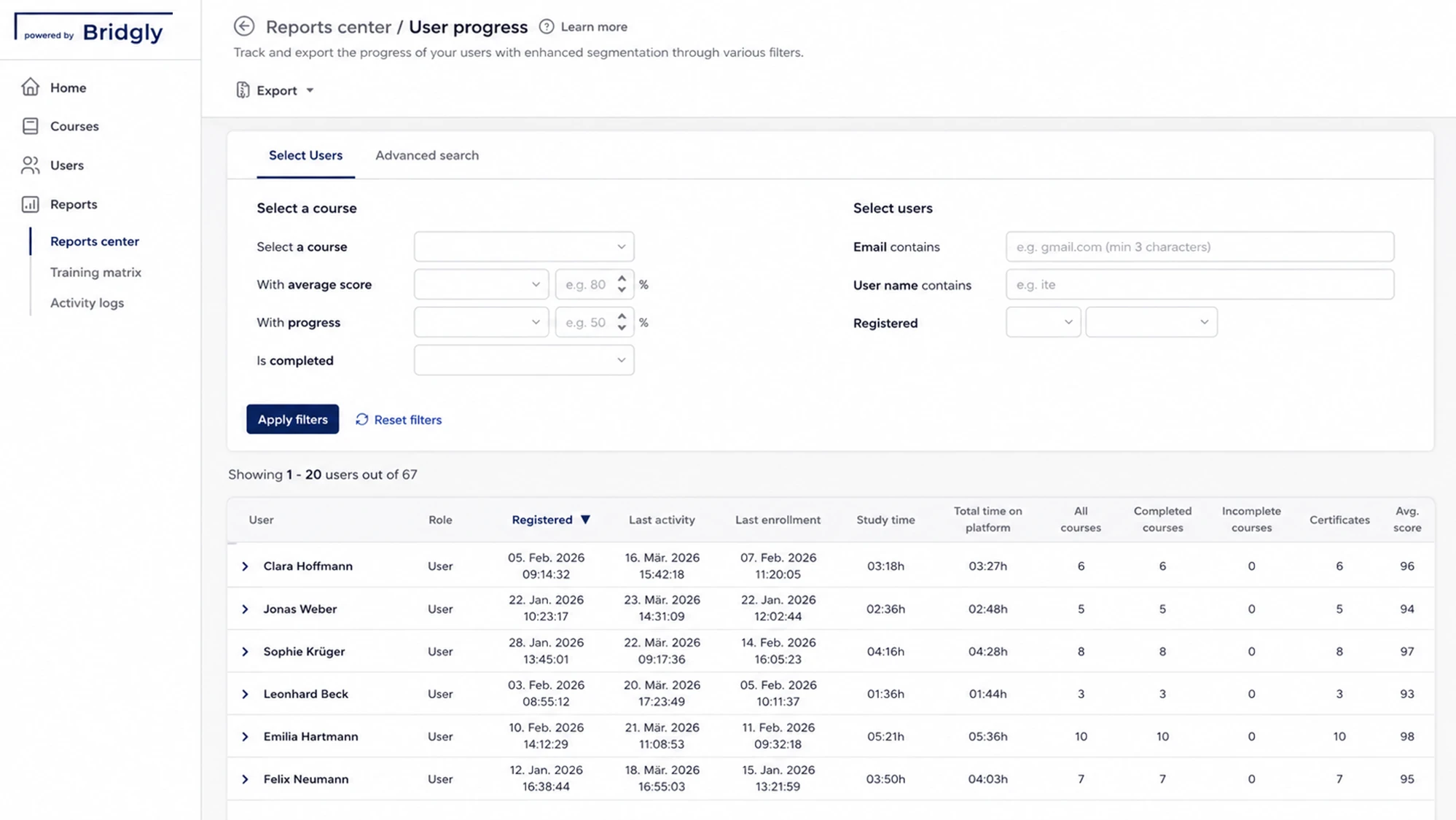
Our platform bundles all training management functions, from planning to reporting, in one place.
Training organization
Define who is trained on which content and when.
Training documentation
See at any time who completed which content and when.
Manage participants
CSV import, learning groups, and access rights in one place.
Automated
reminders
Deadlines and recurring training run automatically.
Here you will find the most important answers.
Training and professional development for companies and public-sector clients – with audit-proof documentation and a practical focus.
Get in touch now
Bridgly is the European training partner for audit-proof, tailored, and automated training and professional development.
 We support the IHK initiative "Pack ma's digital" to help businesses in Upper Bavaria with digitalisation and secure the future of the region.
Note: Some text, images, and videos on this website were generated using artificial intelligence.
All content is for informational purposes and has been carefully reviewed from a journalistic perspective, but does not claim to be exhaustive or legally binding.