Managers can delegate tasks and responsibility clearly to their team without losing control. You learn to formulate assignments unambiguously and to follow up on results appropriately.

55 min
Multimodal
Über 30 Sprachen
Teilnahmebescheinigung
Many managers delegate too little, too late, or unclearly: tasks land with the team without context, responsibilities overlap, and in the end the manager does it themselves after all. This costs time, demotivates employees, and blocks their development. Clear delegation is a craft with rules that can be learned.
00 Fundamentals: why delegating is difficult
01 Recognizing tasks that can be delegated
02 The clear delegation assignment
03 Handing over responsibility and keeping it there
04 Follow-up and feedback
05 Summary
06 Knowledge check incl. certificate of completion
Managers, team leaders, project leads, and up-and-coming managers who delegate tasks and responsibility.
Leading organizations trust Bridgly
.png)

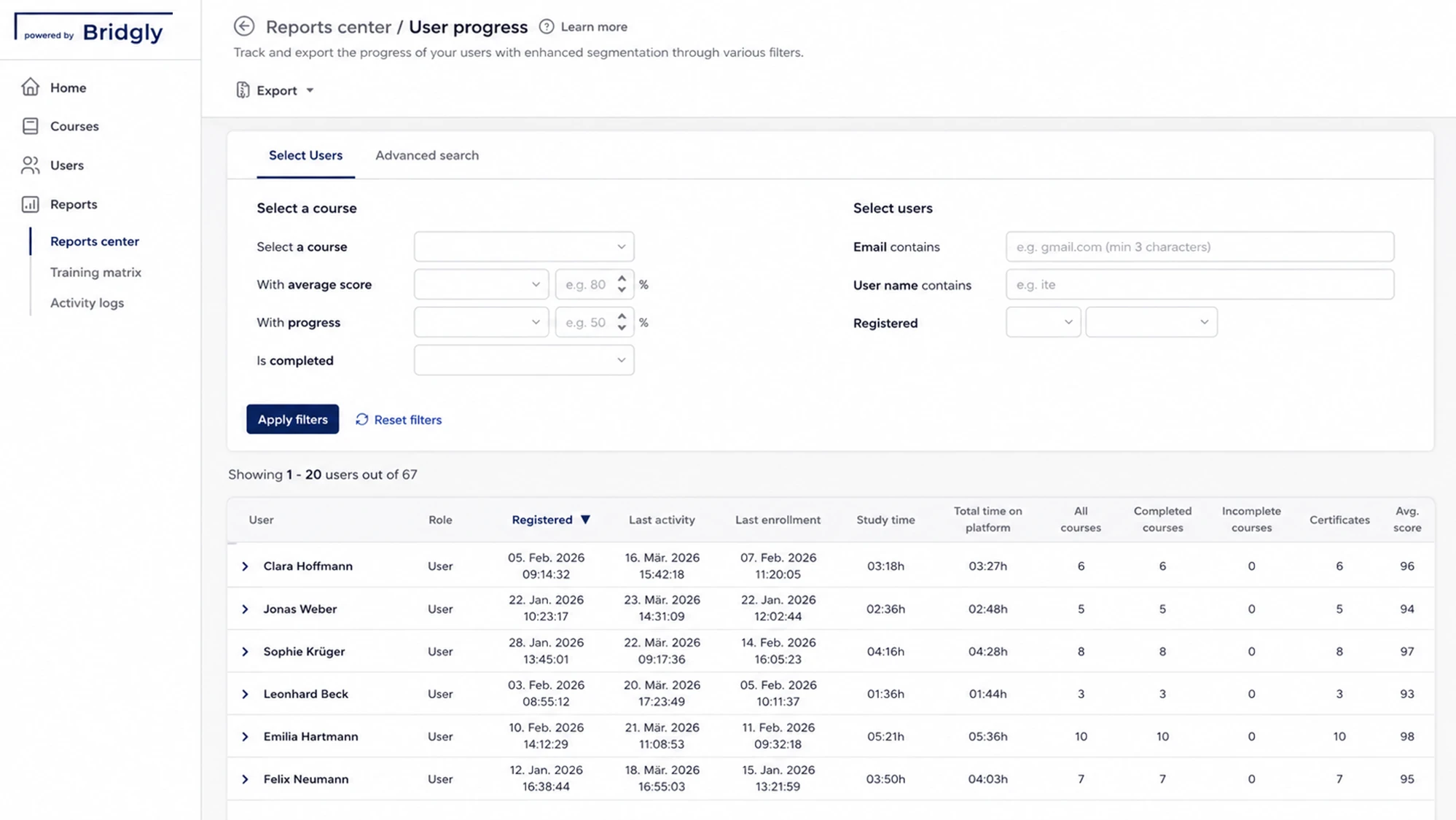
Our platform bundles all training management functions, from planning to reporting, in one place.
Training organization
Define who is trained on which content and when.
Training documentation
See at any time who completed which content and when.
Manage participants
CSV import, learning groups, and access rights in one place.
Automated
reminders
Deadlines and recurring training run automatically.
Here you will find the most important answers.
There is no general obligation to train managers — but there are several topic-specific obligations that apply to them in particular. Under Section 13 (1) no. 4 of the Occupational Health and Safety Act (ArbSchG), persons entrusted with managing an undertaking or an establishment are themselves responsible for fulfilling occupational health and safety obligations within the scope of the tasks and powers assigned to them. Section 13 (2) ArbSchG allows the employer to appoint "reliable and competent persons" in writing — expertise is therefore a prerequisite for an effective delegation of duties. Two further provisions have a direct effect. Section 12 (2) of the General Act on Equal Treatment (AGG) provides: if the employer has trained its employees in a suitable manner to prevent discrimination, this is deemed to fulfill its obligations under subsection 1. And Section 38 (3) of the BSI Act (BSIG) obliges the management of particularly important entities and important entities to regularly participate in training on cybersecurity risks and risk management practices; Section 38 (2) BSIG links this to liability toward the entity itself. This rule was introduced by the NIS-2 implementation act, promulgated on December 5, 2025.
The difference lies in the order of plan and insight. Traditional project management defines scope, deadline, and budget at the outset and manages deviations from them; the agile approach fixes the cadence and keeps the scope variable. The 2001 "Manifesto for Agile Software Development," signed by 17 authors, sets out four pairs of values — including "Responding to change over following a plan" — as well as twelve supporting principles. Scrum gives this cadence a fixed form. The November 2020 version of the Scrum Guide defines three accountabilities (Developers, Product Owner, Scrum Master), five events, and three artifacts (Product Backlog, Sprint Backlog, Increment). Sprints are "fixed length events of one month or less," the Daily Scrum is a 15-minute event, and Sprint Planning is limited to a maximum of eight hours for a one-month Sprint. A Scrum Team typically consists of ten or fewer people. Kanban complements this by making the workflow visible and limiting parallel work.
First, a caveat about the figure that is almost always cited in this context: the claim that 70% of all change initiatives fail is not supported by evidence. In 2011, in the Journal of Change Management, Mark Hughes examined five publications that cite this rate and concluded that there is "no valid and reliable empirical evidence" for this narrative (Volume 11, Issue 4, pages 451–464). The patterns described are more robust. In 1995, John P. Kotter reported in the Harvard Business Review ("Leading Change: Why Transformation Efforts Fail," March/April 1995) that over a decade he had observed more than 100 companies attempting change, and from this he identified recurring mistakes: too little urgency, a guiding coalition that is too weak, a missing or insufficiently communicated vision, victories declared too early. Kurt Lewin had already described the process in 1947 in "Frontiers in Group Dynamics" (Human Relations 1(1), pages 5–41) as a three-step process: unfreezing, moving, freezing. What both models have in common is the assumption that change fails because of people, not because of concepts.
Working time law and occupational health and safety apply unchanged at home. Under Section 3 ArbZG, working time on working days may not exceed eight hours and may only be extended to up to ten hours if an average of eight hours is maintained within six calendar months or 24 weeks; Section 5 (1) ArbZG then requires an uninterrupted rest period of at least eleven hours. On September 13, 2022, the Federal Labour Court (Bundesarbeitsgericht) ruled (1 ABR 22/21) that employers are obliged under Section 3 (2) no. 1 ArbSchG to record the start and end of daily working time. A distinction must also be made between telework workstations and mobile work: Section 2 (7) of the Workplace Ordinance (ArbStättV) only covers display screen workstations in the private sphere that are permanently set up by the employer, with agreed weekly working hours and equipment provided. For such workstations, section 5.2 of the Technical Rules for Workplaces (ASR A6) requires separate instruction on work equipment, ergonomics, and alternating workloads. And Section 3 (2) no. 2 ArbSchG requires that protective measures be observed "integrated into the operational management structures" — here, leadership is part of the legal obligation, not its surroundings.
The seven types of waste (Japanese Muda) go back to Taiichi Ohno and the Toyota Production System. They are: Overproduction — producing more or earlier than is called for; Waiting — standstill due to missing input, approvals, or material; Transportation — unnecessary movement of material, documents, or data; Overprocessing — work steps without value for the recipient; Inventory — accumulated stocks, open cases, unprocessed inboxes; Motion — unnecessary walking and searching; Defects and rework — everything that has to be done a second time. Ohno considered overproduction the most serious form because it brings the other six in its wake. Later authors added an eighth type: the unused knowledge of employees. The same categories apply in administration and services — waiting for approvals, duplicate data entry, follow-up questions. Kanban makes them visible by displaying the workflow and limiting the number of tasks started at the same time.
The Leadership & Management area comprises seven online professional development courses of 55 minutes each, which can be booked individually or as a package. The topics covered are: agile project management in the digital age, change management, leading generations, clearly delegating tasks and responsibilities, hybrid and remote leadership, lean management with Kanban, and innovation in the age of AI. They are aimed at managers, team leaders, project leads, and up-and-coming managers; individual courses are also aimed at product owners, process owners, and team members. Each professional development course follows the same structure of five content modules, a summary, and a final learning assessment, and is available in more than 30 languages. The legally mandatory leadership topics are not included in this area: "Occupational Health and Safety for Managers" (S182) belongs to the Safety & Occupational Health category, and "NIS2/KRITIS: Applicability, Registration, Documentation" (S105) to the Information & Data Security category.
Training and professional development for companies and public-sector clients – with audit-proof documentation and a practical focus.
Get in touch nowNote: Some text, images, and videos on this website were generated using artificial intelligence.

All content is for informational purposes and has been carefully reviewed from a journalistic perspective, but does not claim to be exhaustive or legally binding.